

ISO 27001:2022 Compliance
ISO 27001:2022 is the international standard for information security management systems (ISMS), providing
a framework for organizations to identify risks, implement controls, and continuously
improve cybersecurity practices through systematic policies and procedures.

In an era defined by ubiquitous data and escalating cyber threats, managing information security effectively is no longer optional – it's a strategic imperative.
ISO/IEC 27001:2022, the latest iteration of the globally recognized standard for Information Security Management Systems (ISMS), provides organizations with a robust, systematic framework to protect their sensitive information assets.
Published in October 2022, this version reflects the evolving cybersecurity landscape, emphasizing a proactive, risk-based approach to ensure the confidentiality, integrity, and availability of information.


Overview of ISO 27001:2022
ISO 27001:2022 outlines the requirements for establishing, implementing, maintaining, and continually improving an ISMS. An ISMS is a set of policies, procedures, processes, and systems that manage an organization's information risks, ensuring security is integrated into all aspects of the business. The standard is certifiable, meaning organizations can undergo an independent audit by an accredited certification body to demonstrate their adherence.
Key elements of ISO 27001:2022 include:
- Context of the Organization (Clause 4): Understanding internal and external issues, interested parties, and the scope of the ISMS.
- Leadership (Clause 5): Top management commitment, establishing an information security policy, and assigning roles and responsibilities.
- Planning (Clause 6): Actions to address risks and opportunities, information security objectives, and planning for changes. This includes the crucial risk assessment and risk treatment processes.
- Support (Clause 7): Resources, competence, awareness, communication, and documented information.
- Operation (Clause 8): Operational planning and control, including how risk treatment plans are implemented.
- Performance Evaluation (Clause 9): Monitoring, measurement, analysis, evaluation, internal audit, and management review.
- Improvement (Clause 10): Nonconformity and corrective action, and continual improvement.
A significant update in the 2022 version is the reorganization and refinement of the Annex A controls, which align with ISO/IEC 27002:2022. The 114 controls from the 2013 version have been consolidated into 93 controls, categorized into four themes:
- Organizational Controls (37 controls): Policies, roles, responsibilities, threat intelligence, information classification.
- People Controls (8 controls): Screening, awareness training, remote working, non-disclosure agreements.
- Physical Controls (14 controls): Security perimeters, secure areas, clear desk/screen policy, equipment maintenance.
- Technological Controls (34 controls): Malware protection, backup, logging, network security, secure coding.
The standard emphasizes that organizations should select controls based on their specific risk assessment, rather than implementing all 93 controls universally. This tailored approach allows for more efficient and effective security investments.

Key Aspects of ISO 27001:2022 Compliance
Achieving and maintaining ISO 27001:2022 compliance requires a deep understanding and technical implementation of various controls and processes.
- Risk Assessment and Treatment (Clause 6.1 & Annex A selection):
- Technical Details: This is the cornerstone of ISO 27001. Organizations must define and apply a structured risk assessment methodology to identify, analyze, and evaluate information security risks. This involves identifying information assets, potential threats, vulnerabilities, and their potential impact. The 2022 update continues to emphasize a risk-based approach to selecting controls from Annex A.
- Technical Implementation:
- Automated Vulnerability Scanning: Regularly use tools to scan networks, applications (web, mobile, API), and cloud infrastructure for known vulnerabilities (e.g., CVEs).
- Penetration Testing: Conduct periodic (e.g., annual) black-box and white-box penetration tests to simulate real-world attacks and identify exploitable weaknesses that automated scanners might miss.
- Threat Modeling: Systematically analyze applications and systems during design and development to identify potential security threats and vulnerabilities.
- Risk Registers & GRC Platforms: Utilize governance, risk, and compliance (GRC) software to document risks, track their treatment, and map them to specific Annex A controls.
- Information Security Policy and Organizational Controls (Clause 5 & Annex A.5):
- Technical Details: Establish a clear information security policy and define organizational controls covering information security roles, responsibilities, threat intelligence, and information classification.
- Technical Implementation:
- Security Information and Event Management (SIEM): Implement a SIEM system to aggregate logs from various security devices and systems, providing centralized visibility for threat detection and incident response (A.5.15 Logging and Monitoring).
- Data Loss Prevention (DLP): Deploy DLP solutions to identify, monitor, and protect sensitive information (e.g., NPI, PII, intellectual property) from unauthorized exfiltration (A.5.13 Information Classification and A.5.21 Managing information security incidents).
- Threat Intelligence Platforms: Integrate threat intelligence feeds to stay updated on emerging threats relevant to your organization's assets (A.5.7 Threat Intelligence).
- People Controls (Annex A.6):
- Technical Details: Focus on human aspects of security, including personnel screening, awareness training, and handling remote working.
- Technical Implementation:
- Security Awareness Training Platforms: Implement systems to deliver regular, interactive security awareness training to all employees, covering topics like phishing, social engineering, and secure data handling (A.6.2 Information security awareness, education and training).
- Secure Remote Access Solutions: Implement VPNs with strong encryption and Multi-Factor Authentication (MFA) to secure remote access to organizational networks and systems (A.6.7 Remote Working).
- Physical Controls (Annex A.7):
- Technical Details: Protect physical assets and secure areas.
- Technical Implementation:
- Access Control Systems: Deploy electronic access control systems (e.g., card readers, biometrics) for secure areas, integrated with logging capabilities (A.7.2 Physical entry).
- Environmental Monitoring: Implement systems for monitoring temperature, humidity, and power fluctuations in data centers and server rooms to prevent damage to information assets (A.7.10 Supporting utilities).
- Video Surveillance: Use CCTV and video analytics for monitoring physical security perimeters and secure areas (A.7.2 Physical entry).
- Technological Controls (Annex A.8):
- Technical Details: This category received significant updates, covering a wide range of technical security measures.
- Technical Implementation:
- Malware Protection: Implement endpoint detection and response (EDR) or extended detection and response (XDR) solutions, anti-malware software, and email security gateways (A.8.5 Malware protection).
- Backup and Recovery Solutions: Implement automated, encrypted backup systems with regular testing of recovery procedures (A.8.13 Information backup).
- Network Security: Deploy and configure firewalls, Intrusion Detection/Prevention Systems (IDS/IPS). Implement network segmentation and VLANs to isolate sensitive systems (A.8.16 Network security).
- Secure Configuration (Hardening): Implement automated configuration management tools to ensure systems are hardened according to security baselines (e.g., CIS Benchmarks) and continuously monitored for deviations (A.8.1 Configuration management).
- Access Management: Implement Identity and Access Management (IAM) systems for centralized user authentication and authorization. Enforce Multi-Factor Authentication (MFA) for all critical systems and services (A.8.3 Information access restriction, A.8.4 Access control).
- Cryptography: Implement strong encryption for data at rest and in transit (e.g., AES-256 for storage, TLS 1.2+ for network communications). Manage encryption keys securely using a Key Management System (KMS) (A.8.24 Use of cryptography).
- Secure Development (DevSecOps): Integrate security testing into the Software Development Lifecycle (SDLC) using Static Application Security Testing (SAST) and Dynamic Application Security Testing (DAST) tools for custom applications (A.8.28 Secure coding).
- Logging and Monitoring: Comprehensive logging across all systems and centralized collection/analysis (via SIEM) for anomaly detection and incident investigation (A.8.15 Logging and monitoring).
- Incident Management (Annex A.5.21):
- Technical Details: Establish a clear incident response process to detect, report, assess, respond to, and learn from information security incidents.
- Technical Implementation:
- Incident Response Playbooks: Develop detailed technical playbooks for various incident types (e.g., ransomware, data breach, unauthorized access).
- Forensic Tools: Have tools and capabilities for digital forensics to investigate incidents, preserve evidence, and determine root causes.
- Security Orchestration, Automation, and Response (SOAR): Implement SOAR platforms to automate incident response workflows and improve response times.
- Third-Party Management (Annex A.5.23):
- Technical Details: Address information security within supplier relationships.
- Technical Implementation:
- Vendor Risk Management (VRM) Platforms: Utilize tools to assess and monitor the security posture of third-party vendors who handle or access your organization's information. This includes reviewing their security certifications, audit reports, and conducting technical security assessments.
Why Is ISO 27001:2022 Compliance Important?
ISO 27001:2022 compliance offers a multitude of benefits, extending beyond mere security:
- Enhanced Information Security Posture: By implementing a systematic ISMS, organizations proactively identify and mitigate risks, significantly strengthening their defenses against cyber threats, data breaches, and other security incidents.
- Global Recognition and Trust: ISO 27001 certification is an internationally recognized benchmark for information security. It builds trust and confidence with customers, partners, and stakeholders, demonstrating a serious commitment to protecting sensitive data. This can be a significant competitive advantage.
- Compliance with Legal and Regulatory Requirements: While not a compliance standard itself, ISO 27001 provides a robust framework that significantly aids in meeting the technical and organizational security requirements of various data protection laws and regulations (e.g., GDPR, HIPAA, PCI DSS).
- Improved Business Resilience and Continuity: The standard requires planning for business continuity and disaster recovery, ensuring that critical information systems and data remain available even in the face of disruptive events.
- Cost Savings: By preventing security incidents and optimizing security processes, organizations can avoid the significant financial costs associated with data breaches, regulatory fines, and reputational damage.
- Competitive Advantage and Market Access: Many large organizations and government contracts now require ISO 27001 certification from their suppliers and partners, opening doors to new business opportunities.
- Structured and Continual Improvement: The ISMS framework mandates regular review, audit, and continuous improvement, ensuring that the organization's security posture evolves with new threats and technologies.
- Clear Roles and Responsibilities: It helps to define clear roles, responsibilities, and accountability for information security across the organization.

Who Needs to Comply with ISO 27001:2022?
ISO 27001:2022 is a voluntary international standard, meaning no organization is legally mandated to comply with it unless specified by a contract or specific industry regulation. However, its adoption is highly recommended for any organization that:
- Handles sensitive information: This includes personal data (PII), financial records, intellectual property, trade secrets, health information, or confidential business data. This applies across virtually all sectors: technology, finance, healthcare, legal, government contractors, manufacturing, retail, etc.
- Operates in regulated industries: While not directly mandated, many industry-specific regulations (e.g., financial services, healthcare) implicitly require the implementation of robust security controls that align well with ISO 27001.
- Desires to demonstrate a commitment to security: For organizations looking to prove their security posture to customers, partners, investors, or regulators, ISO 27001 certification provides a credible, third-party verified assurance.
- Works with large enterprises or government bodies: Many larger organizations or public sector entities require their suppliers and service providers to be ISO 27001 certified as a condition for doing business.
- Is looking to gain a competitive advantage: Certification can differentiate an organization in the market, especially in competitive sectors where information security is a key differentiator.
- Is scaling operations or expanding globally: An ISMS provides a scalable and internationally recognized framework for managing information security consistently across different locations and business units.
Essentially, any organization that relies on information and wants to manage its security risks effectively, protect its reputation, and ensure business continuity can benefit from implementing an ISO 27001:2022 compliant ISMS.
ISO 27001:2022 vs GDPR Comparison
ISO 27001:2022 and GDPR (General Data Protection Regulation) are often discussed together, but they serve different purposes: ISO 27001 is a framework for information security management, while GDPR is a legal regulation for data privacy. However, they are highly complementary.
| Feature | ISO 27001:2022 | GDPR (General Data Protection Regulation) |
|---|---|---|
| Type of Standard | Voluntary International Standard for ISMS. Certifiable. | Legally Binding Regulation in the EU. Non-negotiable. |
| Primary Focus | Information Security Management: Protecting the confidentiality, integrity, and availability (CIA) of all types of information assets. | Data Privacy and Protection: Protecting the personal data and privacy rights of EU data subjects. |
| Scope of Data | Applies to all information assets within the defined ISMS scope. | Applies specifically to personal data (information about an identifiable individual). |
| Legal Status | Best practice framework; certification is voluntary. | Law with extraterritorial reach; compliance is mandatory if processing EU personal data. |
| Risk Management | Requires a risk-based approach to all information security risks. | Requires risk assessment (DPIA) for high-risk processing of personal data. |
| Technical Controls | Provides a comprehensive Annex A (93 controls) covering organizational, people, physical, and technological controls. Highly prescriptive on what to secure. | Requires "appropriate technical and organizational measures" (Art. 32); less prescriptive on how to implement. |
| Data Subject Rights | No explicit individual rights (focused on organizational controls). | Grants extensive individual rights (access, erasure, portability, etc.). |
| Accountability | Requires designated roles and responsibilities for ISMS. | Emphasizes accountability (Data Protection Officer, Records of Processing Activities). |
| Breach Notification | Requires an incident management process. | Mandatory 72-hour notification for personal data breaches to supervisory authorities and individuals (if high risk). |
| Purpose | To build, maintain, and improve an effective information security management system. | To standardize data protection laws across the EU and protect data subjects' rights. |
| Enforcement | External audit by certification bodies for certification. | Data Protection Authorities (DPAs) in each EU member state. |
| Penalties | Loss of certification, reputational damage, potential contract loss. | Significant fines (up to €20M or 4% of global annual turnover). |
| Relationship | ISO 27001 provides a strong foundation for achieving the security requirements of GDPR. Certification demonstrates commitment to GDPR's Article 32 (Security of processing). ISO 27701 (Privacy Information Management System) is an extension to 27001 specifically for privacy. | GDPR defines the legal obligations. ISO 27001 is a practical means to implement many of the technical and organizational measures required by GDPR. |
In summary, ISO 27001 is about "how" to manage security for all information, while GDPR is about "what" data (personal data) needs to be protected and "why" (individual rights), with high-level requirements. An organization compliant with ISO 27001 will be well-positioned to meet many of GDPR's security requirements, but it will still need to address the specific privacy principles and individual rights mandated by GDPR.
How to Ensure ISO 27001:2022 Compliance?
Ensuring ISO 27001:2022 compliance is a continuous journey that involves establishing, implementing, operating, monitoring, reviewing, maintaining, and continually improving an ISMS. Here are the key technical steps:
- Define ISMS Scope and Context (Clause 4):
- Technical Action: Identify all information systems, networks, applications, data storage locations (on-premise, cloud), and physical sites that hold or process information critical to your business. Document data flows and interconnections. Use discovery tools to map your digital assets. This informs what falls within the scope of your ISMS.
- Conduct a Comprehensive Risk Assessment and Treatment (Clause 6.1):
- Technical Action: Develop a robust risk assessment methodology.
- Vulnerability Management: Implement continuous vulnerability scanning across your IT infrastructure (networks, servers, applications, cloud environments). Use automated tools for this.
- Penetration Testing: Engage qualified ethical hackers to perform annual penetration tests (web, mobile, API, network, cloud) to identify exploitable vulnerabilities and validate the effectiveness of controls.
- Threat Intelligence: Integrate cyber threat intelligence feeds into your security operations to understand relevant, emerging threats.
- Asset Inventory & Classification: Use tools to maintain an up-to-date inventory of all information assets and classify them based on sensitivity (confidentiality, integrity, availability).
- Risk Register: Maintain a digital risk register to document identified risks, their assessment (likelihood, impact), existing controls, and proposed risk treatment plans (e.g., mitigation, acceptance, transfer).
- Technical Action: Develop a robust risk assessment methodology.
- Implement Selected Controls from Annex A (Clause 8.1):
- Technical Action (Examples from Annex A.8 - Technological Controls):
- Endpoint Protection: Deploy Endpoint Detection and Response (EDR) or Extended Detection and Response (XDR) solutions to protect endpoints from malware and advanced threats (A.8.5).
- Network Security: Implement Next-Generation Firewalls (NGFWs), Intrusion Detection/Prevention Systems (IDS/IPS), and Web Application Firewalls (WAFs). Design and implement network segmentation to isolate sensitive data environments (A.8.16).
- Access Management: Implement Identity and Access Management (IAM) systems for centralized user management. Enforce Multi-Factor Authentication (MFA) for all remote access and access to sensitive systems (A.8.3, A.8.4). Deploy a Privileged Access Management (PAM) solution for administrative accounts (A.8.4).
- Encryption: Implement strong encryption at rest (e.g., database encryption, full disk encryption) and in transit (e.g., TLS 1.2+ for all network communications). Utilize a secure Key Management System (KMS) (A.8.24).
- Logging and Monitoring: Implement comprehensive logging across all systems and deploy a Security Information and Event Management (SIEM) system to collect, correlate, and analyze logs in real-time, enabling rapid threat detection and response (A.8.15).
- Secure Development Practices: Integrate Static Application Security Testing (SAST) and Dynamic Application Security Testing (DAST) tools into your CI/CD pipelines to identify security flaws in custom applications early in the development lifecycle (A.8.28).
- Backup and Recovery: Implement automated, regular, and encrypted backups, with a tested recovery plan (A.8.13).
- Technical Action (Examples from Annex A.8 - Technological Controls):
- Develop an Incident Management Process (Annex A.5.21):
- Technical Action: Establish a formal Incident Response Plan (IRP) outlining technical steps for detection, analysis, containment, eradication, recovery, and post-incident review. Conduct regular tabletop exercises and real-world simulations (e.g., using Breach and Attack Simulation tools) to test the IRP's effectiveness.
- Manage Third-Party Risks (Annex A.5.23):
- Technical Action: Implement a Third-Party Risk Management (TPRM) program. This involves conducting technical security assessments (e.g., security questionnaires, audit report reviews, or requiring penetration test results) of all vendors who handle your organization's information. Ensure contractual agreements include clear security requirements.
- Continuous Monitoring and Improvement (Clauses 9 & 10):
- Technical Action:
- Security Metrics and KPIs: Define and track key performance indicators (KPIs) and metrics related to information security controls.
- Internal Audits: Conduct regular internal audits to verify ISMS effectiveness. This involves technical reviews of implemented controls.
- Management Reviews: Regularly review the ISMS performance at the management level, incorporating feedback from audits, incidents, and performance metrics.
- Security Automation: Use automation to enforce policies, monitor configurations, and respond to threats where feasible.
- Technical Action:
- Documentation and Evidence:
- Technical Action (Support): Maintain meticulous records of all technical controls, configurations, scan results, penetration test reports, incident logs, and evidence of policy enforcement. This documentation is crucial for demonstrating compliance during internal and external audits. The Statement of Applicability (SoA) needs to be continually updated.
Consequences of Non-Compliance with ISO 27001:2022
While ISO 27001 is a voluntary standard, non-compliance, particularly the failure to maintain certification, can lead to significant repercussions:
- Loss of Certification: The most direct consequence is the withdrawal of your ISO 27001 certification by an accredited body. This means you can no longer claim to be ISO 27001 compliant.
- Loss of Customer Trust and Reputation Damage: Certification is often a differentiator and a trust signal. Losing it can severely damage your reputation, signaling to existing and potential customers, partners, and investors that your information security practices are not up to a recognized global standard.
- Loss of Business Opportunities: Many contracts, especially in the B2B sector, government, or highly regulated industries, explicitly require ISO 27001 certification. Non-compliance can lead to the loss of existing contracts and inability to bid for new ones.
- Increased Risk of Security Incidents: Without the structured approach of an ISMS, organizations are more susceptible to cyberattacks, data breaches, and other security incidents, leading to financial losses, operational disruption, and potential legal liabilities.
- Regulatory Penalties (Indirect): While ISO 27001 itself doesn't impose fines, a lack of robust security (indicated by non-compliance) can make it harder to meet the security requirements of other mandatory regulations (like GDPR, HIPAA, PCI DSS). This can then lead to direct fines from those regulatory bodies.
- Higher Insurance Premiums: Cyber insurance providers often look for robust security postures, including certifications like ISO 27001. A lapse in compliance could lead to higher premiums or even denial of coverage.
- Re-certification Costs: If certification is lost, the process to re-certify often involves starting from scratch, incurring significant time, effort, and financial costs.
In essence, while there are no direct fines from "ISO 27001," the business implications of losing or failing to achieve certification are substantial, impacting market position, legal standing, and overall security posture.
How ImmuniWeb Helps Comply with ISO 27001:2022?
ImmuniWeb's AI-powered Application Security Testing (AST) and Attack Surface Management (ASM) platform provides robust technical capabilities that directly support organizations in meeting numerous Annex A controls and overall ISMS requirements of ISO 27001:2022.
 API Penetration Testing
ImmuniWeb conducts deep API penetration testing, uncovering vulnerabilities like insecure endpoints, broken authentication, and data leaks, ensuring compliance with OWASP API Security Top 10.
 API Security Scanning
Automated AI-driven scans detect misconfigurations, excessive permissions, and weak encryption in REST, SOAP, and GraphQL APIs, providing actionable remediation insights.
 Application Penetration Testing
ImmuniWeb provides Application Penetration Testing services with our award-winning ImmuniWeb® On-Demand product.
 Application Security Posture Management
The award-winning ImmuniWeb® AI Platform for Application Security Posture Management (ASPM) helps aggressively and continuously discover an organization's entire digital footprint, including hidden, unknown, and forgotten web applications, APIs, and mobile applications.
 Attack Surface Management
ImmuniWeb continuously discovers and monitors exposed IT assets (web apps, APIs, cloud services), reducing blind spots and preventing breaches via real-time risk scoring.
 Automated Penetration Testing
ImmuniWeb provides Automated Penetration Testing services with our award-winning ImmuniWeb® Continuous product.
 Cloud Penetration Testing
Simulates advanced attacks on AWS, Azure, and GCP environments to identify misconfigurations, insecure IAM roles, and exposed storage, aligning with CIS benchmarks.
 Cloud Security Posture Management (CSPM)
Automates detection of cloud misconfigurations, compliance gaps (e.g., PCI DSS, HIPAA), and shadow IT, offering remediation guidance for a resilient cloud infrastructure.
 Continuous Automated Red Teaming
Combines AI-powered attack simulations with human expertise to test defenses 24/7, mimicking real-world adversaries without disrupting operations.
 Continuous Breach and Attack Simulation (BAS)
Runs automated attack scenarios to validate security controls, exposing weaknesses in networks, apps, and endpoints before attackers exploit them.
 Continuous Penetration Testing
Provides ongoing, AI-augmented pentesting to identify new vulnerabilities post-deployment, ensuring proactive risk mitigation beyond one-time audits.
 Continuous Threat Exposure Management (CTEM)
Prioritizes and remediates risks in real time by correlating threat intelligence with asset vulnerabilities, minimizing exploit windows.
 Cyber Threat Intelligence
Monitors dark web, paste sites, and hacker forums for stolen credentials, leaked data, and targeted threats, enabling preemptive action.
 Data Security Posture Management
The award-winning ImmuniWeb® AI Platform for Data Security Posture Management helps continuously discover and monitor an organization's internet-facing digital assets, including web applications, APIs, cloud storage, and network services.
 Dark Web Monitoring
Scans underground markets for compromised employee/customer data, intellectual property, and fraud schemes, alerting organizations to breaches.
 Mobile Penetration Testing
Tests iOS/Android apps for insecure data storage, reverse engineering risks, and API flaws, following OWASP Mobile Top 10 guidelines.
 Mobile Security Scanning
Automates static (SAST) and dynamic (DAST) analysis of mobile apps to detect vulnerabilities like hardcoded secrets or weak TLS configurations.
 Network Security Assessment
Identifies misconfigured firewalls, open ports, and weak protocols across on-premises and hybrid networks, hardening defenses.
 Penetration Testing-as-a-Service (PTaaS)
Delivers scalable, subscription-based pentesting with detailed reporting and remediation tracking for agile security workflows.
 Phishing Websites Takedown
Detects and expedites takedowns of phishing sites impersonating your brand, minimizing reputational damage and fraud losses.
 Third-Party Risk Management
Assesses vendors’ security posture (e.g., exposed APIs, outdated software) to prevent supply chain attacks and ensure compliance.
 Threat-Led Penetration Testing (TLPT)
Simulates advanced persistent threats (APTs) tailored to your industry, testing detection/response capabilities against realistic attack chains.
 Web Penetration Testing
Manual and automated tests uncover SQLi, XSS, and business logic flaws in web apps, aligned with OWASP Top 10 and regulatory standards.
 Web Security Scanning
Performs continuous DAST scans to detect vulnerabilities in real time, integrating with CI/CD pipelines for DevSecOps efficiency.
By integrating ImmuniWeb's solutions, organizations can gain a comprehensive and continuously updated view of their technical security posture, efficiently identify and remediate vulnerabilities, test their incident response capabilities, and effectively manage third-party risks – all essential components for achieving and maintaining ISO 27001:2022 certification.
List of authoritative resources
Meet Regulatory Requirements with ImmuniWeb® AI Platform
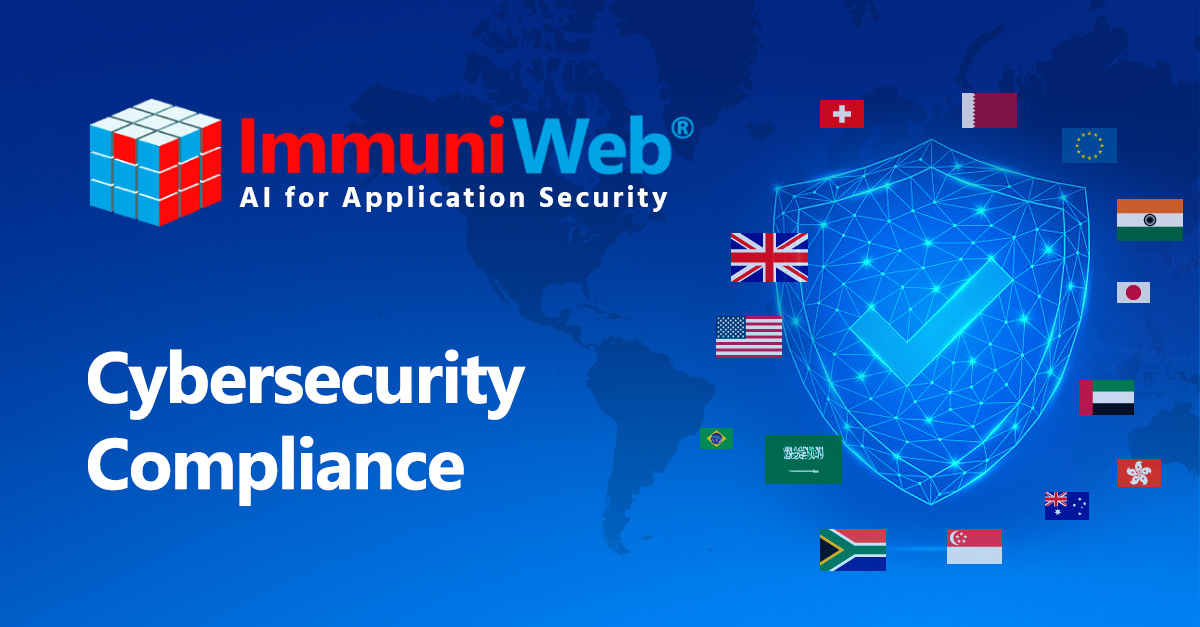
ImmuniWeb can also help to comply with other data protection laws and regulations:
Europe
 EU GDPR
- EU DORA
- EU NIS 2
- EU Cyber Resilience Act
- EU AI Act
- EU ePrivacy Directive
 UK GDPR
 Swiss FADP
- Swiss FINMA Circular 2023/1
North & South America



Middle East & Africa
 Qatar Personal Data Privacy Protection Law
 Saudi Arabia Personal Data Protection Law
- Saudi Arabian Monetary Authority Cyber Security Framework (1.0)
 South Africa Protection of Personal Information Act
 UAE Information Assurance Regulation (1.1)
- UAE Personal Data Protection Law
Asia Pacific
 Australia Privacy Act
 Hong Kong Personal Data Privacy Ordinance
 India Digital Personal Data Protection Act
 Japan Act on the Protection of Personal Information
 Singapore Personal Data Protection Act