

Swiss Federal Act on Data Protection (FADP) Compliance
The Swiss Federal Act on Data Protection (FADP) regulates the processing of personal data to safeguard
individuals' privacy, ensuring transparency, lawful data handling, and granting rights
such as access, correction, and deletion.

Switzerland, known globally for its robust financial sector and commitment to privacy, has significantly strengthened its data protection landscape with the revised Federal Act on Data Protection (FADP), which came into force on September 1, 2023.
This overhaul of the 1992 act aims to align Swiss data protection laws more closely with international standards, particularly the European Union's General Data Protection Regulation (GDPR), while retaining its unique characteristics. The new FADP prioritizes the protection of personal data and the fundamental rights of individuals, imposing stricter obligations on data controllers and processors.


Overview of Swiss FADP
The core purpose of the FADP is to protect the personality and fundamental rights of individuals whose personal data is processed. It establishes principles for the lawful, transparent, and proportionate processing of personal data, covering both physical and electronic data.
Key elements of the revised FADP include:
- Expanded Scope: The new FADP applies to the processing of personal data of natural persons, aligning it with international norms. It explicitly includes an extraterritorial scope, meaning it applies to data processing activities that have an effect in Switzerland, regardless of where the data controller or processor is located.
- Strengthened Data Subject Rights: Individuals are granted enhanced rights, including the right to information, access, rectification, erasure (right to be forgotten under certain conditions), restriction of processing, data portability, and objection to processing, especially in cases of automated decision-making.
- Increased Obligations for Data Controllers and Processors: Organizations are now subject to more stringent requirements, such as maintaining records of processing activities (RoPA), conducting Data Protection Impact Assessments (DPIAs) for high-risk processing, and implementing "Privacy by Design" and "Privacy by Default."
- Enhanced Definition of Sensitive Personal Data: The definition of sensitive personal data has been broadened to include genetic and biometric data, as well as data on administrative or criminal proceedings and social security measures.
- Data Breach Notification: Mandatory notification of data breaches to the Federal Data Protection and Information Commissioner (FDPIC) and, in certain cases, to affected data subjects, is now a key requirement.
- Proportionality Principle: While the FADP imposes robust requirements, it also emphasizes proportionality, meaning that the measures taken should be commensurate with the risks involved and the size and complexity of the organization.

Key Aspects of Swiss Federal Act on Data Protection (FADP) Compliance
Achieving FADP compliance involves addressing several technical and organizational requirements:
- Data Inventory and Mapping: Organizations must create and maintain a comprehensive inventory of all personal data they process. This includes understanding what data is collected, where it is stored, how it is processed, and who has access to it. Technical tools for data discovery and classification are essential here.
- Lawful Basis for Processing: Ensure that all personal data processing activities have a valid legal basis, such as the data subject's consent, performance of a contract, legal obligation, or an overriding legitimate interest.
- Consent Management: Where consent is the legal basis, it must be freely given, informed, specific, and unambiguous. For sensitive personal data or high-risk profiling, explicit consent is required. Technical solutions for consent management platforms (CMPs) are crucial for managing user preferences and demonstrating compliance.
- Privacy by Design and Default: Integrate data protection principles into the design and operation of all new systems, processes, and products from the outset. This means implementing technical and organizational measures (TOMs) such as pseudonymization, encryption, access controls, and data minimization by default.
- Data Protection Impact Assessments (DPIAs): Conduct DPIAs for processing activities likely to result in a high risk to individuals' personality or fundamental rights, especially for large-scale processing of sensitive data or systematic monitoring of public areas. This involves a technical assessment of risks and the identification of mitigation strategies.
- Records of Processing Activities (RoPA): Maintain detailed records of all data processing activities, including categories of data subjects, categories of personal data, purposes of processing, categories of recipients, and retention periods. Automated tools for RoPA management can streamline this process.
- Data Security Measures: Implement appropriate technical and organizational measures to ensure the security of personal data, protecting it from unauthorized or unlawful processing, accidental loss, destruction, or damage. This includes measures like encryption, secure configurations, regular vulnerability assessments, and strong access management.
- Data Breach Notification Procedures: Establish clear internal procedures for detecting, assessing, and reporting data breaches "as soon as possible" to the FDPIC. This includes notifying affected data subjects if necessary. Technical incident response plans are critical.
- International Data Transfers: Implement appropriate safeguards for transferring personal data to countries that do not provide an adequate level of data protection (as determined by the Swiss Federal Council). This often involves using Standard Contractual Clauses (SCCs) or other approved mechanisms, which have technical implications for data flow and security.
- Exercising Data Subject Rights: Develop robust processes and technical mechanisms to facilitate data subjects' exercise of their rights (access, rectification, erasure, portability, objection) within the stipulated timeframes.
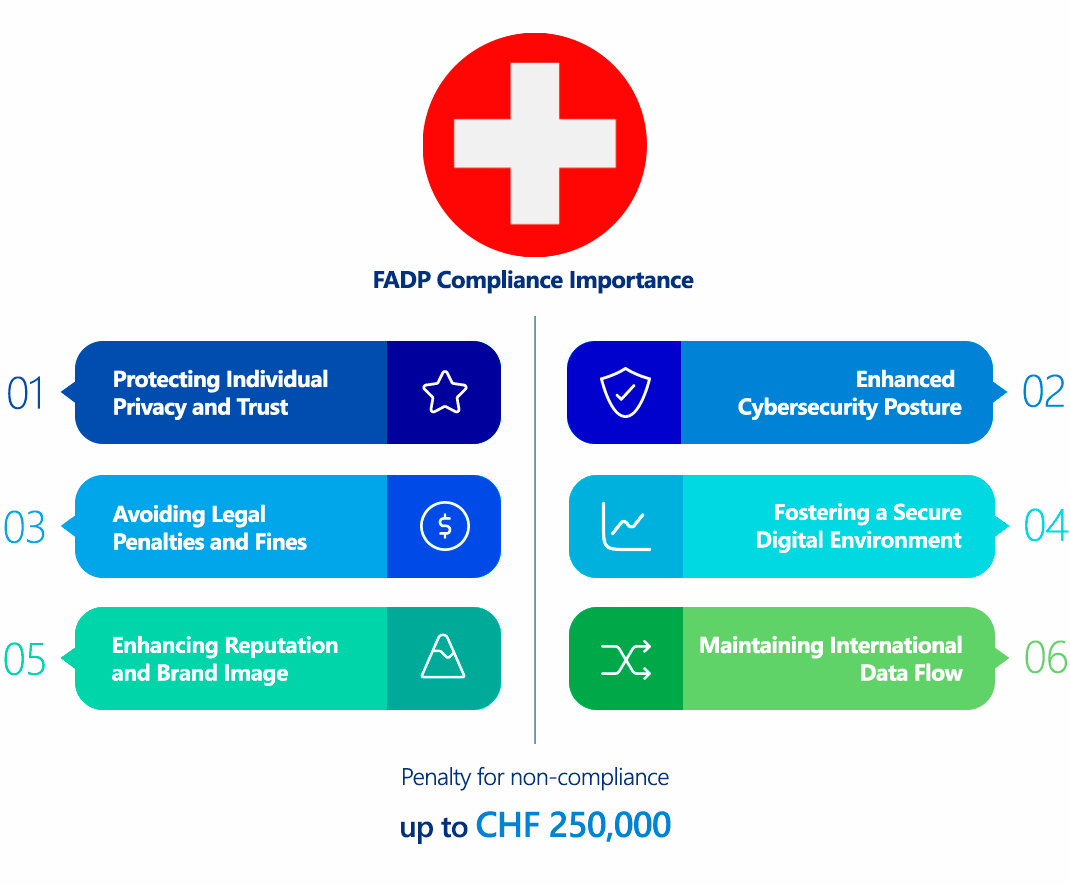
Why Is Swiss Federal Act on Data Protection (FADP) Compliance Important?
Compliance with the FADP is crucial for several reasons:
- Protecting Individual Privacy and Trust: At its core, the FADP safeguards the privacy and fundamental rights of individuals, fostering trust between organizations and their customers.
- Avoiding Legal Penalties and Fines: Non-compliance can lead to significant criminal penalties, primarily targeting responsible individuals within an organization (up to CHF 250,000), and potentially the company itself (up to CHF 50,000 if the individual responsible cannot be identified with disproportionate effort).
- Maintaining International Data Flow: The FADP's alignment with GDPR helps Switzerland maintain its "adequacy status" with the EU, enabling seamless and legally compliant cross-border data transfers with EU/EEA countries. This is vital for Swiss businesses operating internationally.
- Enhancing Reputation and Brand Image: Demonstrating strong data protection practices enhances an organization's reputation, builds customer loyalty, and gives a competitive edge in a privacy-conscious market.
- Mitigating Operational and Reputational Risks: Data breaches and privacy infringements can lead to significant financial losses, reputational damage, and disruption of business operations. Compliance helps mitigate these risks.
- Fostering a Secure Digital Environment: By mandating robust security measures and promoting "Privacy by Design," the FADP contributes to a more secure and trustworthy digital environment.
Who Needs to Comply with Swiss FADP?
The FADP has a broad scope and applies to:
- Any private individual or federal body that processes personal data.
- Organizations (both private and public) located within Switzerland that process personal data.
- Organizations located outside Switzerland that process personal data of individuals within Switzerland, especially if their processing activities relate to offering goods or services to individuals in Switzerland or monitoring their behavior in Switzerland (extraterritorial scope).
This means that companies worldwide that interact with Swiss individuals, store data on Swiss servers, or have an "effect" in Switzerland, must comply with the FADP.
Swiss FADP vs. GDPR Comparison
The revised FADP has many similarities with the GDPR, often being referred to as "GDPR Switzerland." However, there are notable distinctions:
| Feature | Swiss FADP (Revised, effective Sep 2023) | GDPR (General Data Protection Regulation) |
|---|---|---|
| Scope of Data | Personal data of natural persons only. Broader definition of "sensitive data" includes genetic, biometric, administrative/criminal proceedings, and social security measures. | Personal data of natural persons only. "Special categories of personal data" include racial/ethnic origin, political opinions, religious/philosophical beliefs, trade union membership, genetic, biometric, health, sex life/orientation. |
| Territorial Scope | Extraterritorial: Applies to data processing with an "effect" in Switzerland, even if the processing takes place abroad. | Extraterritorial: Applies to processing of personal data of EU/EEA residents, regardless of the controller/processor's location, if offering goods/services to them or monitoring their behavior. |
| Legal Basis for Processing | Requires a "justification" for processing, such as consent, legal obligation, or overriding private/public interest. Less prescriptive on "legal bases" than GDPR for non-sensitive data. | Requires a "lawful basis" for processing (e.g., consent, contract, legal obligation, vital interests, public task, legitimate interests). More explicit categories. |
| Consent | Must be freely given, informed, and unambiguous. Explicit consent required for sensitive data or high-risk profiling. | Must be freely given, specific, informed, and unambiguous. Explicit consent required for special categories of data. Stricter conditions (e.g., no pre-ticked boxes). |
| Data Protection Officer (DPO) | Not mandatory, but highly recommended for certain organizations (referred to as a "Data Protection Advisor"). | Mandatory for public authorities, organizations engaged in large-scale systematic monitoring, or large-scale processing of special categories of data. |
| Data Breach Notification | To FDPIC "as soon as possible" if likely to result in a high risk to data subjects. Notification to data subjects if necessary for their protection or required by FDPIC. No fixed timeframe. | To Supervisory Authority within 72 hours of becoming aware, if likely to result in a risk to rights and freedoms. Notification to data subjects if likely to result in a high risk. |
| Data Protection Impact Assessment (DPIA) | Mandatory for processing activities likely to result in a high risk. Exemption for smaller businesses under certain conditions. | Mandatory for processing activities likely to result in a high risk. |
| Records of Processing Activities (RoPA) | Mandatory for most organizations, with exemptions for small and medium-sized enterprises (SMEs) with low-risk processing. | Mandatory for most organizations, with exemptions for SMEs under certain conditions. |
| Sanctions | Primarily criminal sanctions (fines up to CHF 250,000) against responsible individuals (e.g., CEOs, DPOs). Fines up to CHF 50,000 against the company if identifying the responsible individual is disproportionately difficult. | Primarily administrative fines (up to €20 million or 4% of global annual turnover for serious infringements). |
| Transfers to Third Countries | Adequacy decisions by the Swiss Federal Council. SCCs or other approved mechanisms for non-adequate countries. | Adequacy decisions by the European Commission. SCCs, BCRs, or other approved mechanisms for non-adequate countries. |
How to Ensure Swiss Federal Act on Data Protection (FADP) Compliance?
Ensuring FADP compliance requires a systematic and ongoing effort, integrating technical and organizational measures:
- Conduct a Data Audit and Mapping: Start by identifying all personal data collected, stored, processed, and shared. Document data flows, processing purposes, and retention periods. Tools for data discovery and classification are essential here.
- Review Legal Bases: For each processing activity, confirm and document the valid legal basis (consent, contract, legal obligation, legitimate interest).
- Implement Robust Consent Mechanisms: For consent-based processing, deploy a Consent Management Platform (CMP) that captures informed, specific, and explicit consent (where required). Ensure users can easily withdraw consent.
- Strengthen Data Security: Implement comprehensive technical and organizational security measures, including:
- Encryption and Pseudonymization: Apply these techniques to protect data at rest and in transit.
- Access Controls: Implement strict role-based access controls (RBAC) to ensure only authorized personnel can access personal data.
- Vulnerability Management: Conduct regular vulnerability assessments and penetration testing on systems and applications processing personal data.
- Security Monitoring and Incident Response: Implement security information and event management (SIEM) solutions to monitor for suspicious activity and develop a robust incident response plan for data breaches.
- Secure Software Development Lifecycle (SSDLC): Integrate security into every phase of software development ("Privacy by Design").
- Conduct DPIAs: For high-risk processing, perform Data Protection Impact Assessments (DPIAs) to identify and mitigate privacy risks. This involves detailed technical analysis of data flows and potential impacts.
- Maintain RoPA: Implement a system (manual or automated) to maintain accurate and up-to-date Records of Processing Activities (RoPA).
- Update Privacy Policies and Notices: Ensure privacy policies are transparent, easily understandable, and clearly inform data subjects about data processing activities, their rights, and international data transfers.
- Manage Third-Party Risks: Conduct due diligence on all third-party vendors and service providers who process personal data on your behalf. Ensure contracts include FADP-compliant data processing clauses and audit their security practices.
- Train Employees: Provide regular and mandatory data protection and security awareness training to all employees who handle personal data.
- Establish Data Subject Rights Procedures: Develop clear and efficient procedures for handling data subject requests (e.g., access, rectification, erasure, portability) within the stipulated timeframes.
- Appoint a Representative (if necessary): Organizations outside Switzerland processing Swiss data on a large scale or high-risk basis may need to appoint a representative in Switzerland.
Consequences of Non-Compliance with Swiss FADP
The FADP introduces stricter penalties compared to its predecessor, emphasizing personal accountability:
- Criminal Fines: The most significant consequence is the potential for criminal fines of up to CHF 250,000 for responsible individuals within an organization who intentionally violate certain FADP provisions. These can include:
- Failure to provide required information or provide false information.
- Failure to cooperate with the FDPIC.
- Violations of professional secrecy obligations related to data.
- Unlawful disclosure of personal data.
- Company Fines: If the responsible individual cannot be identified with disproportionate effort, the company itself can be fined up to CHF 50,000.
- Reputational Damage: Data breaches or public enforcement actions due to non-compliance can severely damage an organization's reputation, erode customer trust, and lead to significant financial losses from lost business.
- Civil Claims: Affected data subjects may have the right to pursue civil claims for damages resulting from FADP violations.
- Increased FDPIC Scrutiny: Non-compliant organizations may face increased oversight, audits, and corrective measures from the FDPIC.
How ImmuniWeb Helps Comply with Swiss FADP?
ImmuniWeb's AI-powered Application Security and Attack Surface Management platform offers robust capabilities that directly support FADP compliance, particularly in the realm of technical and organizational security measures:
 API Penetration Testing
ImmuniWeb conducts deep API penetration testing, uncovering vulnerabilities like insecure endpoints, broken authentication, and data leaks, ensuring compliance with OWASP API Security Top 10.
 API Security Scanning
Automated AI-driven scans detect misconfigurations, excessive permissions, and weak encryption in REST, SOAP, and GraphQL APIs, providing actionable remediation insights.
 Application Penetration Testing
ImmuniWeb provides Application Penetration Testing services with our award-winning ImmuniWeb® On-Demand product.
 Application Security Posture Management
The award-winning ImmuniWeb® AI Platform for Application Security Posture Management (ASPM) helps aggressively and continuously discover an organization's entire digital footprint, including hidden, unknown, and forgotten web applications, APIs, and mobile applications.
 Attack Surface Management
ImmuniWeb continuously discovers and monitors exposed IT assets (web apps, APIs, cloud services), reducing blind spots and preventing breaches via real-time risk scoring.
 Automated Penetration Testing
ImmuniWeb provides Automated Penetration Testing services with our award-winning ImmuniWeb® Continuous product.
 Cloud Penetration Testing
Simulates advanced attacks on AWS, Azure, and GCP environments to identify misconfigurations, insecure IAM roles, and exposed storage, aligning with CIS benchmarks.
 Cloud Security Posture Management (CSPM)
Automates detection of cloud misconfigurations, compliance gaps (e.g., PCI DSS, HIPAA), and shadow IT, offering remediation guidance for a resilient cloud infrastructure.
 Continuous Automated Red Teaming
Combines AI-powered attack simulations with human expertise to test defenses 24/7, mimicking real-world adversaries without disrupting operations.
 Continuous Breach and Attack Simulation (BAS)
Runs automated attack scenarios to validate security controls, exposing weaknesses in networks, apps, and endpoints before attackers exploit them.
 Continuous Penetration Testing
Provides ongoing, AI-augmented pentesting to identify new vulnerabilities post-deployment, ensuring proactive risk mitigation beyond one-time audits.
 Continuous Threat Exposure Management (CTEM)
Prioritizes and remediates risks in real time by correlating threat intelligence with asset vulnerabilities, minimizing exploit windows.
 Cyber Threat Intelligence
Monitors dark web, paste sites, and hacker forums for stolen credentials, leaked data, and targeted threats, enabling preemptive action.
 Data Security Posture Management
The award-winning ImmuniWeb® AI Platform for Data Security Posture Management helps continuously discover and monitor an organization's internet-facing digital assets, including web applications, APIs, cloud storage, and network services.
 Dark Web Monitoring
Scans underground markets for compromised employee/customer data, intellectual property, and fraud schemes, alerting organizations to breaches.
 Mobile Penetration Testing
Tests iOS/Android apps for insecure data storage, reverse engineering risks, and API flaws, following OWASP Mobile Top 10 guidelines.
 Mobile Security Scanning
Automates static (SAST) and dynamic (DAST) analysis of mobile apps to detect vulnerabilities like hardcoded secrets or weak TLS configurations.
 Network Security Assessment
Identifies misconfigured firewalls, open ports, and weak protocols across on-premises and hybrid networks, hardening defenses.
 Penetration Testing-as-a-Service (PTaaS)
Delivers scalable, subscription-based pentesting with detailed reporting and remediation tracking for agile security workflows.
 Phishing Websites Takedown
Detects and expedites takedowns of phishing sites impersonating your brand, minimizing reputational damage and fraud losses.
 Third-Party Risk Management
Assesses vendors’ security posture (e.g., exposed APIs, outdated software) to prevent supply chain attacks and ensure compliance.
 Threat-Led Penetration Testing (TLPT)
Simulates advanced persistent threats (APTs) tailored to your industry, testing detection/response capabilities against realistic attack chains.
 Web Penetration Testing
Manual and automated tests uncover SQLi, XSS, and business logic flaws in web apps, aligned with OWASP Top 10 and regulatory standards.
 Web Security Scanning
Performs continuous DAST scans to detect vulnerabilities in real time, integrating with CI/CD pipelines for DevSecOps efficiency.
By leveraging ImmuniWeb, Swiss organizations can proactively identify and mitigate technical risks to personal data, streamline their security operations, and build a demonstrable framework for robust FADP compliance.
List of authoritative resources
Meet Regulatory Requirements with ImmuniWeb® AI Platform
ImmuniWeb can also help to comply with other data protection laws and regulations:
Europe
 EU GDPR
- EU DORA
- EU NIS 2
- EU Cyber Resilience Act
- EU AI Act
- EU ePrivacy Directive
 UK GDPR
 Swiss FADP
- Swiss FINMA Circular 2023/1
North & South America



Middle East & Africa
 Qatar Personal Data Privacy Protection Law
 Saudi Arabia Personal Data Protection Law
- Saudi Arabian Monetary Authority Cyber Security Framework (1.0)
 South Africa Protection of Personal Information Act
 UAE Information Assurance Regulation (1.1)
- UAE Personal Data Protection Law
Asia Pacific
 Australia Privacy Act
 Hong Kong Personal Data Privacy Ordinance
 India Digital Personal Data Protection Act
 Japan Act on the Protection of Personal Information
 Singapore Personal Data Protection Act